Car Clicks Once But Won't Start: Causes and Fixes
When your car clicks once but won’t start, the click only proves that part of the starting circuit responded. It does not prove that the battery, cables, solenoid, or starter motor can deliver the power needed to turn the engine. The safest diagnosis begins with the battery connections, not a replacement starter.
Listen for where the click comes from and watch what the lights do at the same time. Those two clues can separate a low-power problem from a starter or mechanical fault.
What One Click Usually Means
| What you notice | More likely causes | Best next step |
|---|---|---|
| One click and the lights dim heavily | Weak battery under load, loose terminal, damaged cable, poor ground, or starter drawing too much current | Inspect the main connections and load-test the battery |
| One click and the lights stay bright | Starter-control fault, worn solenoid contacts, failed starter motor, or open high-current cable | Have the complete starter circuit tested |
| The click comes from the fuse box | Starter relay or control-circuit fault | Check the correct fuse and relay using the owner’s manual |
| The click comes from the engine area | Starter solenoid, starter motor, cable, ground, or locked engine | Stop repeated attempts and arrange electrical testing |
| One click is followed by grinding or a whir | Starter drive or flywheel engagement problem | Do not keep trying to start the engine |
A normal resting voltage is not enough to rule out the battery. A weak battery may operate the lights and still fail under starter load. If the battery’s fitted size or rating is uncertain, compare it with the CCA requirement estimator.
Make Sure It Is One Click
The pattern matters. One firm click followed by silence is different from a fast series of clicks. Rapid clicking usually means voltage falls, the relay or solenoid releases, voltage recovers, and the cycle repeats. The cause may be a discharged battery or resistance at a cable connection.
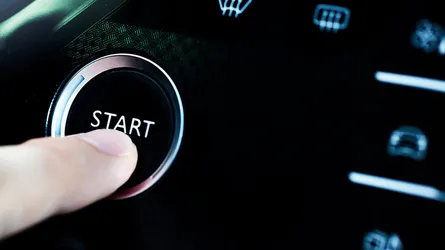
No sound at all points elsewhere. The vehicle may not be receiving a start request because of a fuse, relay, ignition switch, push-button control, key-recognition problem, or safety interlock. A slow turning engine also belongs in a different group because the starter is moving, but not at normal speed.
Try only a brief start attempt while you listen. Repeated attempts can heat the starter and cables without revealing anything new.
Check the Battery and Main Connections First
DENSO’s starter troubleshooting procedure begins with a battery load test, a charging-system check, and inspection of the battery cables and connections. That order matters because a poor connection can mimic a failed starter.
With the ignition off and the key removed:
- Check that both battery terminals are secure. A terminal that moves by hand needs attention.
- Look for white, blue, or green corrosion around each terminal.
- Inspect the visible positive cable toward the starter and the negative cables toward the body and engine.
- Look for loose fasteners, broken strands, swollen insulation, or corrosion spreading under the cable covering.
- Have the battery load-tested or conductance-tested if it was checked only with a voltmeter.
Do not wiggle a cable while someone turns the key. Do not place a tool across the battery terminals. If the vehicle has marked jump-start points, use only the procedure in its owner’s manual or call for roadside help.
Check the Start Conditions and Security System
A starter may stay disabled if the vehicle does not detect the correct transmission position, clutch position, brake input, or key. These faults often cause silence, but some vehicles may still operate a relay that makes one click.
- Put an automatic transmission firmly in Park. Hold the brake and try Neutral once.
- On a manual vehicle, select Neutral, apply the parking brake, and press the clutch fully.
- Watch the security or key warning light during the start attempt.
- Try the spare key or fob if one is available.
- Use the owner’s manual to find the correct backup starting method for a weak key-fob battery.
- Check only the starter fuse and relay identified for that vehicle.
Park, Neutral, and clutch interlocks are safety devices. NHTSA explains that a starter interlock prevents an automatic vehicle from starting while its transmission is in a drive position. Never bridge an interlock, relay, or solenoid terminal to make the engine crank.
When the Starter or Solenoid Is the Likely Cause
The starter assembly usually contains a solenoid and an electric motor. The solenoid moves the starter drive into position and closes the high-current circuit. The motor then turns the engine. Worn contacts, brushes, windings, bearings, or drive parts can leave you with a click and no cranking.
Intermittent starting can fit a worn starter, but it can also come from a loose cable or failing relay. A successful jump start does not prove which part failed. Extra power may temporarily overcome a weak battery, connection resistance, or a worn starter.
The useful professional checks are:
- Battery performance under load
- Voltage at the battery during the start attempt
- Voltage loss across the positive and ground sides of the starter circuit
- Current draw by the starter
- Start-command voltage at the solenoid
- Starter and engine rotation, when the electrical results require it
DENSO recommends testing the complete circuit and keeping total voltage loss within 0.5 volts during cranking. These measurements happen around high-current terminals and moving engine parts. Leave them to a technician unless you have the vehicle’s service information, suitable equipment, and safe access.
Do not strike the starter. Do not bridge its terminals with a wire or tool. A spark, short circuit, unexpected engine movement, or sudden start can cause serious harm.
Less Common Mechanical Causes
If the battery and starter circuit test correctly, the engine may be hard or impossible to turn. Possible causes include an internal engine failure, liquid in a cylinder, a seized belt-driven accessory, or damage where the starter gear meets the flywheel or flexplate.
Clues that raise concern include:
- The engine stopped with a loud mechanical noise.
- An oil-pressure or temperature warning appeared before it stopped.
- The vehicle drove through deep water.
- Coolant or oil was lost.
- The click is joined by grinding, scraping, or a strained hum.
Do not force the crankshaft with a long bar or keep operating the starter. A technician can remove the drive belt or spark plugs when appropriate, then check engine rotation without adding damage.
A Safe Diagnostic Order
Follow this sequence before buying parts:
- Confirm whether you hear one click, repeated clicks, or no click.
- Watch whether the dashboard and headlights dim during the attempt.
- Make sure the transmission and security system allow starting.
- Inspect the battery terminals and visible main cables with the ignition off.
- Load-test the battery and check why it lost charge, if applicable.
- Scan for diagnostic trouble codes when a control or security fault is possible.
- Have the starter circuit tested for voltage loss, current draw, and a valid start command.
- Check for a mechanical lock only after the electrical system passes its tests.
This order prevents a common mistake: replacing the starter before proving that it receives enough power and a proper command.
When to Stop Trying and Get Help
Stop start attempts if a cable becomes hot, the lights go completely dark, you smell burning insulation or fuel, smoke appears, or the starter grinds. Use roadside help if the vehicle cannot remain securely in Park or Neutral.
If the battery passes a proper load test but the engine still will not turn, follow the broader guide for when a car won’t start but battery is good. If the battery repeatedly loses charge between trips, investigate why the car battery keeps dying before replacing the starter.
Tell the technician where the click seemed to come from, what the lights did, whether Park and Neutral behaved differently, and how the battery was tested. Those details are more useful than guessing which part needs replacement.