Why Does My Car Battery Keep Dying All the Time? Causes and Tests
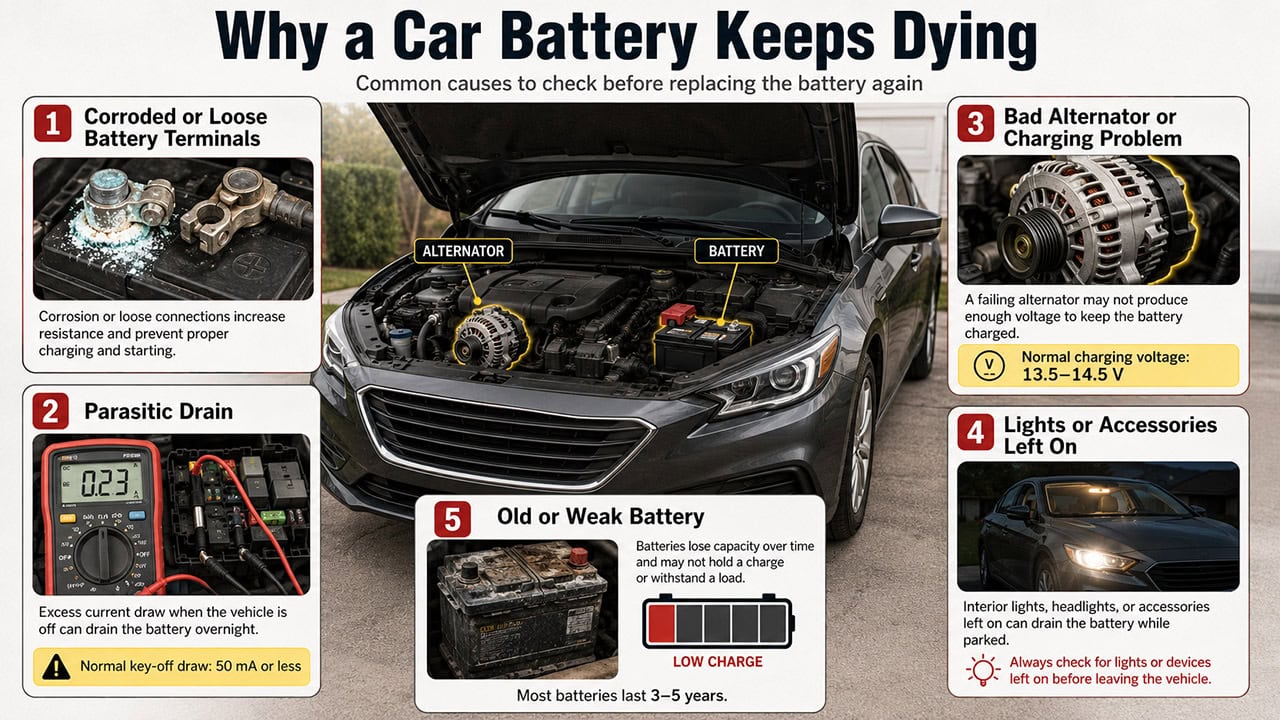
Why does my car battery keep dying all the time? Repeated failure means the battery is losing charge, cannot store enough energy, cannot receive a full charge, or cannot deliver power through its cables. Replacing it without separating those four problems can leave a new battery dead too.
The timing gives you the first clue. A battery that dies while parked points toward battery condition or key-off draw. A car that loses power while driving points toward the charging system or its connections. Slow cranking after short trips may mean the battery never gets fully recharged.
If the battery has tested good but the engine still will not crank, use the car won’t start but battery is good guide to check the starter circuit and controls.
The Four Checks That Stop Repeat Failures
- Battery capacity: Fully charge the battery, then test whether it can store energy and supply starting current.
- Cable condition: Inspect the posts, clamps, grounds, and positive cable, then measure voltage drop under load.
- Charging performance: Check the belt, alternator control, warning light, wiring, and output under the vehicle’s test conditions.
- Key-off current: Let the vehicle enter sleep mode, measure draw safely, and identify the circuit that stays awake.
Use the failure pattern to choose where to spend time:
| When it dies | Most useful first check |
|---|---|
| Overnight | Lights, aftermarket devices, module sleep, and key-off draw |
| After several parked days | Battery capacity, normal standby load, and driving pattern |
| While driving | Belt, alternator, cables, grounds, and charging-system faults |
| After repeated short trips | State of charge and whether driving restores the energy used |
| Soon after battery replacement | Correct battery type, connections, charging, draw, and required registration |
| Only in cold weather | Battery capacity, cable resistance, and correct cold-cranking rating |
Handle a Damaged Battery Safely
This guide covers the low-voltage starting battery. Do not touch orange high-voltage cables or traction-battery parts in a hybrid or electric vehicle.
Do not jump-start or charge a battery that is cracked, leaking, swollen, frozen, hissing, or unusually hot. Keep sparks, flames, and smoking materials away. Wear eye and skin protection and provide ventilation. Ford’s 12-volt battery precautions warn that batteries can produce explosive gases and contain sulfuric acid.
Follow the owner’s manual before disconnecting, charging, or jump-starting. Some vehicles have more than one low-voltage battery, a remote jump point, or a battery sensor that must not be bypassed.
Test the Battery After a Full Charge
Start with the case, hold-down, posts, and date code. A loose battery can damage itself and its connections. Corrosion, a cracked case, low electrolyte in a serviceable flooded battery, or a bulging side needs attention before electrical testing.
Measure voltage directly on the battery posts, not on the cable clamps. Resting voltage estimates state of charge, but it does not prove the battery has useful capacity. Battery chemistry, temperature, recent charging, and surface charge affect the reading.
As a general reference, an OEM troubleshooting guide lists about 12.6 volts for a fully charged flooded battery and 12.8 volts for a fully charged AGM battery after surface charge is handled. The same battery testing guide filed with NHTSA says the battery should be fully charged before further testing. Use the specifications for your battery and tester rather than treating one voltage as universal.
A battery can show normal open-circuit voltage and still collapse under starter load. After charging it with a charger approved for its chemistry, use a conductance or load test that matches the battery type and rating. Replace it only when the test reports failure or the case is unsafe.
A discharged new battery is not automatically defective. Charge and test it first, then find out why it lost charge.
Check Cables and Grounds Under Load
Clean-looking connections can still have resistance inside a crimp or under a clamp. Inspect:
- Positive and negative battery clamps
- Battery-to-body ground
- Engine or transmission ground strap
- Positive cable to the starter and power distribution point
- Alternator output cable and connector
- Battery sensor on the negative cable, if fitted
- Battery hold-down and cable routing
Try to move each battery clamp by hand with the engine off. It should not twist on the post. Follow the owner’s manual for disconnection. On a conventional negative-ground vehicle, the negative cable normally comes off first and goes on last, but vehicle-specific instructions take priority.
A voltage-drop test finds resistance while current is flowing. Measure across each cable and connection during cranking or charging, then compare the result with service information. This is more useful than an unloaded resistance check on a heavy cable.
If slow cranking becomes one solid click, follow the car clicks once but won’t start checks. A good battery cannot overcome a failed starter, solenoid, cable, or ground.
Test the Charging System as a Controlled System
A battery warning light that stays on with the engine running usually reports a charging-system fault, not simply an old battery. Check the belt and tensioner first, then scan for charging and battery-monitoring codes.
Do not condemn an alternator because its voltage does not stay between two fixed numbers. Many modern vehicles change alternator output based on battery state, temperature, electrical load, deceleration, and computer commands. A Stellantis diagnostic notice states that smart charging can show low voltage at idle and tells technicians to verify the strategy before replacing the alternator.
A complete test may include:
- Battery state of charge and battery-test result
- Commanded and actual generator output
- Voltage at the battery posts under several loads
- Voltage drop on positive and ground paths
- Alternator current when the system commands charge
- AC ripple or diode condition
- Belt, pulley, tensioner, fuse, and wiring condition
- Battery-current sensor data and related codes
Use the charging-system voltage checker to organize voltage, ripple, and cable-drop readings. The service manual remains the final source for limits.
If the engine shuts off while driving and later restarts after a jump, compare the pattern with a car that stalls and starts back up. A battery that keeps the car alive only briefly after a jump often points to lost charging output.
Find Key-Off Draw Without Waking the Car
Every modern vehicle uses some power when parked. The correct sleep time and allowable draw vary by model and equipment. Do not assume that every car must sleep in 15 minutes or stay below one universal milliamp limit.
Before measuring, check simple causes:
- Glove-box, trunk, vanity, cargo, or under-hood lights
- Dashcams, trackers, alarms, remote starters, and audio equipment
- USB adapters, diagnostic devices, and accessories left in powered outlets
- A key or phone that keeps waking passive-entry systems
- Doors, latches, or hood switches that report open
- Stuck relays or modules that never enter sleep
- Recent wiring, collision, water, or software problems
Close or latch every opening without locking yourself out. Keep the key away, turn off accessories, and wait for the specified sleep period. Some vehicles take much longer than others. A recent Subaru diagnostic bulletin notes that an active network or a missed wait period can make a parasitic-draw test look high before sleep.
A low-current clamp meter can measure draw without disconnecting the battery. Another useful method is measuring voltage drop across fuses, which can identify an active circuit without pulling a fuse and waking modules.
A series ammeter can work, but it is easy to misuse. Fluke’s parasitic-drain testing guidance says to start in the high-current jack and range, allow modules to sleep, and never crank the engine or operate high-current devices while the meter carries current. Opening a door or switching on a lamp can blow the meter fuse.
Once the vehicle is asleep and the measured draw is above its specification, isolate the circuit. Fuse voltage-drop testing often preserves sleep better than pulling fuses one by one. After finding the circuit, inspect every device on it instead of blaming the fuse.
Use the parasitic-draw battery drain calculator to estimate how a measured draw compares with battery capacity. The result is an estimate because temperature, battery health, starting needs, and module behavior change the usable time.
Short Trips, Long Parking, and Weather
Starting removes energy, and the alternator needs enough running time and spare output to replace it. There is no magic trip length that works for every vehicle. Temperature, traffic, accessory use, battery size, alternator strategy, and the battery’s state of charge all matter.
If the car makes only short trips, measure state of charge over several days. Combine trips when practical or use a smart maintainer approved for the battery type and connected according to the owner’s manual. A maintainer is also useful for a seasonal vehicle that sits for long periods.
Heat speeds battery aging. Cold reduces available starting power and makes the engine harder to crank. Cold weather often exposes a battery that already lost capacity rather than causing the entire failure overnight. Test the battery and cables before extreme weather instead of relying on age alone.
Never charge a frozen battery. Move it to a safe place and follow the battery maker’s instructions.
Install the Battery the Vehicle Requires
Match the original group size, terminal position, hold-down style, cold-cranking rating, reserve capacity, and chemistry. A start-stop vehicle may require AGM or EFB technology and a charger or tester set to that type.
Use the CCA requirement estimator as a reasonableness check, then confirm the required rating in the owner’s manual or parts catalog. The battery group size finder helps check physical fit, but the vehicle specification decides the final choice.
Do not replace AGM or EFB with a basic flooded battery unless the manufacturer approves the change. Some vehicles also require battery registration, coding, or a battery-monitor reset after replacement. A Porsche technical notice, for example, says its listed AGM battery must not be replaced with a conventional starter battery and requires replacement data to be entered in the gateway.
Make sure the battery sensor and vent tube are restored, where fitted. A correct battery installed without the required reset or connection may still charge poorly.
A Diagnostic Order That Prevents Another Failure
- Inspect the case, hold-down, terminals, belt, and warning lights.
- Fully charge the battery with the correct charger.
- Test battery capacity using the correct chemistry and rating.
- Measure cable voltage drop during cranking and charging.
- Test commanded charging output, loaded voltage, and ripple.
- Review driving pattern and time parked.
- Prepare the vehicle for sleep and measure key-off draw safely.
- Isolate the active circuit without repeatedly waking the network.
- Repair the fault, recharge the battery, and repeat the failed test.
- Install the specified battery and perform any required registration or reset.
A replacement battery is the answer only when capacity testing shows it cannot do its job. If cables, charging, or key-off draw caused the discharge, repair that fault first so the next battery receives and keeps a full charge.