High Car Engine Idle RPM: Causes and Safe Checks
High car engine idle RPM can be normal for a short time after a cold start, but it needs attention when the engine stays fast after warming up. The most useful clues are when it happens, whether the speed is steady or surging, and whether recent work changed the throttle or intake system.
A fast idle is usually caused by extra air entering the engine, a throttle that does not close as expected, or a control module reacting to incorrect data. Do not adjust screws or replace sensors based on RPM alone. A few safe observations and scan-tool readings can narrow the fault first.
What a Fast Idle Usually Means
- Fast only after a cold start: Often normal if the speed steadily falls as the engine warms.
- Steady and high when fully warm: Check for an air leak, an open idle air control valve, a throttle that is held open, or an idle-learn problem.
- Idle rises and falls: Look for an intermittent air leak, a sticking idle control part, incorrect coolant-temperature data, or a control problem.
- High after throttle cleaning, replacement, or battery work: The vehicle may need its model-specific idle or throttle relearn.
- High after other engine work: Recheck every vacuum hose, intake duct, connector, and ground disturbed during the repair.
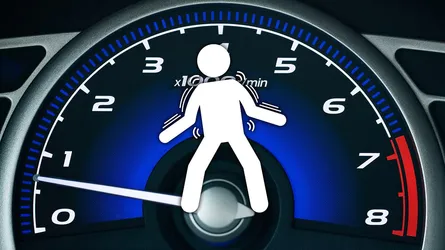
- RPM increases but the engine shakes: Treat it as a rough-running or misfire problem, not a simple fast idle.
There is no correct universal idle number. A fast idle is one that remains above the manufacturer’s warm target after temporary cold-start and accessory loads have ended. Check the vehicle’s service information, and compare actual RPM with commanded idle if your scan tool shows it.
Cold Fast Idle Versus a Warm Fault
The engine computer may command extra airflow after a cold start. This helps the engine run smoothly and warms the catalytic converter. Ford’s owner guidance on cold-start idle explains that idle speed can start higher and then fall as the converter warms.
A small increase can also occur when the air conditioner, rear defroster, steering load, or heavy electrical load is active. The computer adds airflow to keep the engine from stalling.
Suspect a fault when the speed stays well above its normal warm value, rises after the engine is warm, hangs between shifts, or makes the vehicle pull hard against the brakes. If the problem is mainly a low or falling speed, use the guide to RPM dropping while idle instead.
Act Quickly if the Throttle Sticks
A high idle at a stop is different from a vehicle that keeps accelerating after you release the pedal. If that happens while driving, press the brake firmly and steadily, shift to Neutral, steer to a safe place, stop, shift to Park, and switch off the engine. General Motors gave the same core steps in safety instructions filed with NHTSA. Do not pump the brake because that can reduce vacuum assist.
Do not drive the car if the pedal does not return, the throttle linkage binds, a floor mat traps the pedal, or the brake pedal becomes unusually hard. Inspect these items with the engine off.
Check the Pedal, Cable, and Throttle First
Remove loose objects from the driver’s footwell and make sure the floor mat is secured. Press and release the accelerator with the engine off. It should move smoothly and return without help.
On an older cable-operated throttle, inspect the cable for fraying, sharp bends, rust, or excess tension. The throttle lever should return to its stop when the pedal is released. Do not tighten the cable to improve response. It needs the amount of free play listed by the manufacturer.
Do not turn the factory throttle-stop screw. It sets a calibrated base position and is not a normal idle adjustment. Changing it can hide the original fault and create a new throttle-position problem.
Electronic throttle bodies do not have an accelerator cable. Check the connector and intake duct, but do not force the plate or apply power to the motor. Use the service procedure for cleaning and testing because designs differ.
Scan for Codes and Read Live Data
Scan the engine computer before clearing codes or disconnecting the battery. The U.S. Environmental Protection Agency explains how the OBD system stores diagnostic trouble codes for monitored faults. Use the OBD-II code lookup to identify the system involved.
Codes that can help direct a fast-idle diagnosis include:
- P0507: Idle speed higher than the computer expected
- P0505 or related idle-control codes: Idle control system fault
- P0171 and P0174: Lean operation, which may come from unmetered air or weak fuel delivery
- P0120- or P0220-series codes: Throttle or accelerator-position circuit faults
- P0100-series codes: Airflow or air-pressure measurement faults
- EVAP purge codes: A purge valve or its control circuit may be involved
A code does not prove that the named sensor or valve is bad. Inspect its wiring, hoses, power, ground, and related live data before replacing it.
Useful live data includes commanded idle speed, actual RPM, throttle angle, accelerator position, coolant temperature, airflow, purge command, and fuel trims. If the car has been parked overnight, coolant and intake-air readings should begin reasonably close to the surrounding temperature. A coolant reading that is far too cold can keep the computer in a warm-up strategy.
Use the fuel-trim interpreter to compare correction at idle and at a steady higher speed. Unmetered air often has a greater effect at idle, when normal airflow is low.
Find Intake Air Leaks Safely
Air entering after the airflow meter or past the closed throttle can raise warm idle. Inspect these common leak points:
- PCV valve, diaphragm, and hoses
- Brake-booster hose and check valve
- EVAP purge hose and valve
- Intake duct between the airflow meter and throttle
- Vacuum hoses and plastic fittings
- Throttle-body and intake-manifold gaskets
- Injector seals where they meet the intake
- Any hose removed during recent service
Listen for a hiss and look for split elbows, loose clamps, oil-softened rubber, disconnected caps, and pinched seals. A hard brake pedal can indicate a large booster-side leak and needs prompt attention.
A smoke machine is safer and more reliable than spraying carburetor cleaner or starting fluid around a running engine. An OEM service bulletin hosted by NHTSA shows visual inspection and smoke testing used to confirm a split vacuum hose. Use regulated test equipment and the vehicle’s service procedure. Do not pressurize the intake with unrestricted shop air.
Idle Air Control on Cable-Throttle Cars
Many older engines use an idle air control valve, often called an IAC valve. It meters air around a closed mechanical throttle plate. A valve stuck open, a damaged seal, or an electrical fault can hold idle too high.
Check for IAC-related codes and compare commanded idle with actual RPM. Inspect the connector and wiring before removing the valve. If the manufacturer allows cleaning, use the stated cleaner and do not twist or push a delicate motorized pintle. Replace the valve only after testing shows it cannot respond or seal correctly.
Newer electronic-throttle vehicles usually control idle by moving the throttle plate itself. They may not have a separate IAC valve, so buying one based on generic advice wastes time.
Throttle Deposits and Idle Relearn
Throttle deposits can change the airflow available at the learned closed position. Cleaning may help on some vehicles, but it can also expose a larger air opening than the computer had learned to expect. That can cause a high or surging idle until the correct relearn is completed.
An American Honda service bulletin documents P0507 and a fluctuating idle after throttle-body service when the computer has not relearned the current closed position. The bulletin uses a scan tool and a model-specific idle-learn procedure.
Do not assume that disconnecting the battery for ten minutes will relearn every car. Some vehicles learn automatically under exact temperature and load conditions. Others need a scan-tool command. Follow the procedure for the engine and model.
If the idle became high right after intake, timing-cover, or turbo work, recheck hose routing before cleaning anything. A Subaru technical notice shows how two swapped hoses after engine service can create an internal vacuum leak and P0507.
Coolant Temperature and Other Inputs
The computer uses coolant temperature to decide how much cold-start airflow and fuel the engine needs. A sensor or wiring fault that reports an engine colder than it is can hold the warm-up strategy too long.
Compare scan-tool temperature with the actual engine state. Check the connector for coolant, corrosion, loose pins, and damaged wiring. Do not remove the sensor from a hot, pressurized cooling system.
Also compare the accelerator-position and throttle-position signals with your foot off the pedal. A signal that does not return to its learned rest value needs circuit and mechanical testing. Modern systems usually detect mismatched signals and may enter reduced-power mode, so a pedal sensor is not a reason to replace parts without codes and data.
Less Common Causes
Move to these only after the intake, throttle, idle control, codes, and live data have been checked:
- EVAP purge valve stuck open: Can act like an intake leak and may cause hard starting or roughness after refueling.
- Incorrect mechanical or ignition timing: More relevant after engine work or on an older distributor-equipped engine.
- Charging-system or voltage fault: Low or unstable voltage can upset electronic controls, but a failed alternator does not automatically make idle rise.
- Wiring or ground fault: Intermittent voltage at the throttle, IAC, or control module can change idle behavior.
- Control-module fault: Possible, but far less likely than an air leak, wiring problem, dirty throttle, or missing relearn.
A rich fuel-pressure problem, blown fuse, or bad computer should not be assumed from fast idle alone. Test the system before ordering an expensive part.
A Practical Diagnostic Order
- Warm the engine and switch off optional loads, then record the actual RPM.
- Check the pedal area, throttle return, cable condition, and recent work.
- Scan for stored and pending codes without clearing them.
- Compare commanded idle, actual RPM, coolant temperature, throttle data, and fuel trims.
- Inspect the intake, PCV, brake-booster, and EVAP hoses.
- Use a proper smoke test when a leak is still suspected.
- Test the IAC or electronic throttle using model-specific instructions.
- Perform a throttle or idle relearn only when the service information calls for it.
- Investigate timing, voltage, wiring, or control-module faults if the earlier checks support them.
If the idle is rough mainly during a cold start, follow the checks for a car that idles rough when cold. If the scan shows a cylinder-specific fault, use the misfire code helper before replacing coils or plugs.
A lasting repair comes from finding why the engine receives too much air or why the computer is requesting it. Confirm that the engine is fully warm, protect against a sticking throttle, save the scan data, and test the intake and throttle system in that order.