Car Won't Accelerate Past 40 MPH: 12 Causes and Fixes
- Engine
- 01 Jan, 2025
You press down on the gas pedal expecting your car to speed up, but the speedometer refuses to climb past 40 mph. Traffic backs up behind you, horns blare, and your vehicle simply will not go any faster. Something is preventing your car from reaching normal highway speeds, and you need to figure out what is wrong before your next trip turns dangerous.
When a car cannot accelerate past 40 mph, the problem usually falls into one of three categories. Your vehicle might be stuck in limp mode, a protective state that limits speed and power to prevent engine or transmission damage. You could have a transmission problem that prevents higher gears from engaging properly. Or your engine might lack the power to push the car faster due to fuel delivery issues, sensor failures, or exhaust restrictions. The good news is that many of these problems have affordable fixes once you identify the root cause.
A car stuck at 40 mph typically has one of three issues: the computer activated limp mode to protect the drivetrain, the transmission cannot shift into higher gears, or the engine lacks power due to fuel, air, or sensor problems.
What This Problem Costs You
Highway Driving Capability:
Completely Lost
Passing and Merging Safety:
Dangerously Compromised
Engine and Transmission Risk:
High if Ignored
This speed limitation makes your car unsafe for highway driving, interstate travel, or any road where traffic moves faster than 40 mph. You cannot merge safely, pass slower vehicles, or keep up with normal traffic flow. Beyond the immediate inconvenience, continuing to drive with an underlying problem can cause expensive damage to your engine, transmission, or catalytic converter.
Use the RPM vs speed calculator to check whether your engine RPM matches expected values at 40 mph. If your tachometer shows unusually high RPM at that speed, your transmission is likely not shifting properly.
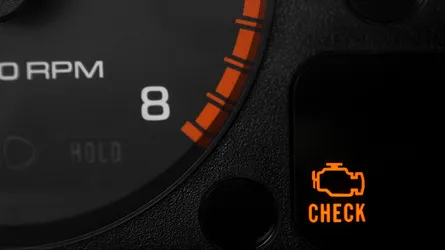
Start diagnosis by checking for warning lights on your dashboard. The check engine light, transmission temperature light, or reduced power warning often accompany speed limitations. Use the OBD-II error code lookup to decode any diagnostic trouble codes stored in your vehicle computer.
1. Limp Mode Activation
The Problem: Your vehicle’s engine control module (ECM) or transmission control module (TCM) detected a serious fault and activated limp mode to protect the drivetrain. Limp mode deliberately limits engine power and transmission function to prevent catastrophic damage while allowing you to drive slowly to a repair shop.
Common triggers for limp mode:
-
Transmission overheating: Fluid temperature too high from towing, stop-and-go traffic, or low fluid level
-
Sensor failures: Mass airflow sensor, throttle position sensor, or transmission speed sensors sending bad data
-
Boost pressure problems: Turbo or supercharger issues triggering protective limits
-
Emission system faults: Catalytic converter or oxygen sensor failures can trigger power reduction
What To Do: Pull over safely and turn off the engine for a few minutes. Sometimes this resets limp mode temporarily. If the car still limits speed after restarting, you need to scan for diagnostic codes to identify the underlying fault that triggered limp mode.
2. Transmission Not Shifting Into Higher Gears
Warning Signs: Engine revs high but car does not speed up, transmission slips between gears, harsh shifting, or transmission stuck in one gear. You may notice the tachometer climbing to 4000-5000 RPM at only 40 mph.
When your transmission cannot shift from second or third gear into higher gears, your car physically cannot reach highway speeds. The engine revs higher and higher, but without access to overdrive or fourth gear, there is a hard limit on how fast the wheels can turn.
Automatic transmissions rely on hydraulic pressure, solenoids, and electronic controls to shift gears. A failure in any of these systems can trap the transmission in a lower gear. Low transmission fluid is the most common cause and the easiest to check.
Diagnosis: Check your transmission fluid level and condition with the engine running and transmission warm. The fluid should be pink or red and smell slightly sweet. Dark brown or black fluid with a burnt smell indicates internal damage. Low fluid means there is a leak somewhere that needs repair.
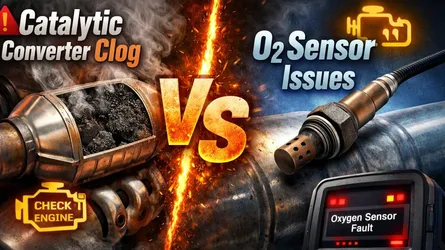
3. Clogged Catalytic Converter
A plugged catalytic converter creates severe exhaust restriction that chokes your engine. As exhaust gases cannot escape, backpressure builds in the combustion chambers and prevents the engine from producing enough power to push the car past 40 mph.
Catalytic converters fail when the internal honeycomb substrate melts or becomes coated with carbon deposits. This often happens after prolonged misfiring, burning oil, or running too rich (excess fuel). The converter may also fail from age, especially on vehicles with over 100,000 miles.
A professional exhaust backpressure test confirms whether the catalytic converter is restricted. Some mechanics use a temperature gun to check for hot spots that indicate internal damage.
If your engine also won’t rev past 4000 RPM, exhaust restriction is a likely culprit affecting both speed and RPM limits.
4. Failing Fuel Pump
Your fuel pump must deliver enough pressurized gasoline to support higher engine speeds and loads. When the pump weakens, it can supply adequate fuel for city driving but starves the engine when you demand more power for highway speeds.
Fuel starvation causes the engine to stumble, hesitate, or simply refuse to accelerate beyond a certain point. The engine might feel fine at lower speeds but hit a wall when you try to go faster or climb hills.
Common signs of fuel pump failure include engine sputtering at high speeds, loss of power during acceleration, difficulty starting when the engine is hot, and surging at steady speeds.
A fuel pressure test reveals whether the pump delivers adequate pressure under load. Many auto parts stores will loan you a fuel pressure gauge, or a mechanic can perform this test quickly.
5. Clogged Fuel Filter
Start Here First: If you cannot remember when your fuel filter was last replaced, change it now. Fuel filters should be replaced every 20,000 to 30,000 miles, and a clogged filter is one of the cheapest causes of speed limitation to fix.
The fuel filter traps dirt, rust, and debris before they reach your fuel injectors. Over time, these contaminants accumulate and restrict fuel flow. Your engine may run fine at low speeds but struggle when fuel demand increases during acceleration.
A restricted fuel filter starves the engine of gasoline exactly when you need more power. The result is a car that accelerates normally up to a point, then refuses to go any faster no matter how hard you press the gas pedal.
Replacing the fuel filter is inexpensive and straightforward on most vehicles. This should be one of your first checks when diagnosing acceleration problems.
6. Faulty Throttle Position Sensor
The throttle position sensor (TPS) tells your engine computer how far you have pressed the gas pedal. When this sensor fails or sends incorrect data, the computer does not know you want more power and limits throttle response accordingly.
A faulty TPS can make the engine computer think you are barely touching the accelerator even when you have the pedal floored. The computer responds by limiting fuel injection and ignition timing, which caps your acceleration and top speed.
Symptoms include inconsistent acceleration, surging at steady speeds, poor idle quality, and hesitation when you press the gas. The check engine light usually illuminates with TPS-related trouble codes.
Testing the TPS requires a multimeter or scan tool to verify the sensor outputs correct voltage as the throttle opens. Replacement is usually affordable and accessible on most vehicles.
7. Dirty or Faulty Mass Airflow Sensor
The mass airflow (MAF) sensor measures air entering the engine so the computer can calculate the correct fuel mixture. When the MAF sensor is dirty or malfunctioning, the engine runs with incorrect air-fuel ratios that reduce power output.
A contaminated MAF sensor often causes the engine to run lean (not enough fuel), which limits power especially during acceleration. You may notice poor fuel economy, rough idle, hesitation, and reduced throttle response along with the speed limitation.
Cleaning the MAF sensor with specialized MAF cleaner spray often restores proper function. If cleaning does not help, the sensor may need replacement. Either way, this is a relatively inexpensive fix compared to transmission or engine repairs.
8. Transmission Fluid Problems
Automatic transmissions depend on clean fluid at the proper level to shift correctly. Low fluid prevents the transmission from building enough hydraulic pressure to engage higher gears. Contaminated or burnt fluid causes erratic shifting and can damage internal components.
Check your transmission fluid level according to your owner’s manual instructions. Most vehicles require the engine running and transmission in park or neutral. The fluid should be at the correct level and appear pink or light red without a burnt smell.
If the fluid is low, top it off and check for leaks. If the fluid is dark, smells burnt, or contains metal particles, a transmission flush or more extensive repair may be necessary.
9. Faulty Vehicle Speed Sensor
The vehicle speed sensor (VSS) tells the engine and transmission computers how fast the car is moving. When this sensor fails, the transmission may not know when to shift gears, and the engine computer may limit power because it cannot accurately calculate vehicle speed.
A bad speed sensor often causes erratic speedometer readings, improper shift points, and activation of limp mode. The transmission may hunt between gears or refuse to shift out of lower gears entirely.
Diagnosis requires checking for speed sensor trouble codes and testing the sensor output with an oscilloscope or scan tool. Replacement is usually straightforward once you locate the sensor on your specific vehicle.
10. Electronic Throttle Body Malfunction
Modern vehicles use electronic throttle bodies controlled by the engine computer rather than a mechanical cable connection. When the throttle body motor, position sensor, or wiring fails, the computer limits throttle opening as a safety measure.
A malfunctioning electronic throttle body may only open partially regardless of pedal position. This directly limits how much air enters the engine and caps your maximum speed and acceleration.
Symptoms include reduced power, jerky acceleration, and a check engine light with throttle-related codes. Some vehicles display a “reduced power” or “limp home” warning on the dashboard.
Throttle body cleaning sometimes resolves minor issues caused by carbon buildup. More serious problems require throttle body replacement or repair of wiring and connectors.
11. Turbo or Supercharger Failure
Boosted Engines Only: If your vehicle has a turbocharger or supercharger, forced induction problems can severely limit power output. A failing turbo can trigger limp mode and limit vehicle speed to protect the engine from damage.
Turbocharged and supercharged engines rely on forced induction to make their rated power. When the boost system fails, the engine produces significantly less power than normal, which may prevent highway speeds.
Common boost system failures include wastegate problems, boost leaks in intercooler piping, failed blow-off valves, and turbo bearing failure. The engine computer monitors boost pressure and triggers limp mode if readings fall outside normal parameters.
Listen for unusual turbo sounds like whistling, grinding, or excessive whooshing. Check intercooler piping for loose connections or cracked hoses that leak boost pressure.
12. Severe Engine Mechanical Problems
Critical Warning: If your engine makes knocking, grinding, or rattling noises along with the speed limitation, stop driving immediately. Continuing to drive with serious mechanical damage can destroy the engine completely.
Major engine problems like low compression, worn timing components, or internal damage can reduce power output so severely that the car cannot accelerate past 40 mph. These issues require professional diagnosis and often expensive repairs.
Signs of serious engine problems include visible smoke from the exhaust, oil consumption, metal particles in the oil, and unusual noises during operation. A compression test can reveal whether internal engine damage is limiting power.
If your engine shows signs of major mechanical failure, a mechanic needs to assess whether repair is economical compared to engine replacement or vehicle replacement.
Get Back to Highway Speeds Safely
A car stuck at 40 mph needs prompt attention before the underlying problem causes more damage or puts you in a dangerous situation. Start by scanning for diagnostic codes to narrow down the cause. Check transmission fluid level and condition, inspect the fuel filter, and look for obvious signs of exhaust restriction.
Many speed limitations come from limp mode activation, which itself is triggered by other faults. Fixing the root cause often restores normal operation. Do not ignore warning lights or continue driving at limited speed longer than necessary to reach a safe location or repair shop.
If your tachometer also shows high RPM at low speed, see engine won’t rev past 4000 RPM for related diagnosis. For power loss during acceleration, read engine loses power at full throttle.